

|
|

Page 1 of 2:
This is the first part of a series of 3 articles by Walter Pall on the subject of collecting wild trees (yamadori). Originally printed in Bonsai Today #74,75 and 76, these articles fueled my own ambition to collect old, wild trees for use as bonsai. The information contained within these articles were of enormous help in not only successfully collecting and ensuring the survival of my collected trees, but also in teaching the respect necessary before one removes trees from the wild. HH
More of Walters work can be seen at his website http://walter-pall.de
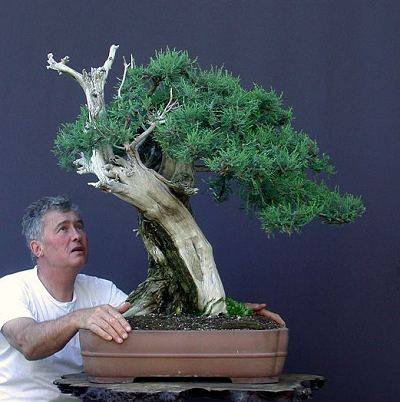
The author with an ancient collected Juniper
The Ethics of Collecting Trees from the Wild
There are opposing positions on this subject. Both those who defend this activity and those who oppose it have their reasons for adopting one position or the other, reasons that will be explored.
Why obtain material for bonsai from the Wild if it is something that is not very attractive and, in addition, looks as if it would be a very laborious task?
Those who
are favour of it have several reasons in defence of their position:
· Many native species, often the best for bonsai training,
are very difficult or impossible to find in a nursery.
· In the nursery, trees are cultivated to grow as rapidly
as possible and generate money. This means that, in many cases,
they will not have the desired quality for bonsai.
· Trees grown from seed or cuttings need decades to reach
a quality similar to that of trees collected from nature. Even
then, there is an enormous difference in quality.
· The character of a tree only develops with age. A collected
tree expresses the struggle for survival through its appearance
and bark. This is very difficult to achieve with nursery seedlings.
· Collected trees have a unique history, written expressly
for each one of them, making them more interesting and desirable.
· Collecting trees from nature can be fun and some might
even go so far as to consider it a sport.
Why should these trees not be collected?
Those who
oppose this activity also are supported by good reasons:
· In the majority of cases, the trees will not survive
the procedure.
· Even though permission maybe available, it is a license
to kill if you do not know exactly what you are doing.
· Independent of the fact that trees are never collected
in nature reserves or parks, they always come from a specific
biological habitat.
· Collected trees often need years to re-establish themselves
before actual shaping can begin.
· For those who are not experts, many trees collected
from the mountain have too much character. Quite possibly they
will not know how to make use of their potential.
Of course
in all civilised countries, just going into fields anywhere
and collecting trees is forbidden. There is always a property
owner, even though it may be the government.
For that reason, it is essential to get permission for the collection
of plants. It is best to study beforehand where and what it
is that you want to collect. Generally it is possible to obtain
permission, except for trees in nature reserves or parks. If
you explain to the forest ranger or farmer that you are looking
for very small trees of lower quality and that afterwards, footprints
will be erased and holes filled, usually you can count on getting
a favourable response. Often, they can even tell you where you
should begin looking.
They may also think you are crazy, but that is something you
will have to accept.
It is best
to get written permission in order to avoid difficulties that
may arise later on. Many good areas belong to farmers who have
a habitual relationship with trees that often even includes
being bothered by them. Sometimes, a small compensation accompanied
by the promise that holes will be filled is sufficient.
Clearly, you may also find people who think that a fortune can
be made from bonsai. For that reason, it is better to say young
are looking for specimens for your garden. It is a small lie
that harms no one.
The collector of bonsai may face danger during the hunting season, generally in Autumn, so be particularly careful in this season.
Anyone who
does not have much experience with trees and does not know with
certainty how and if it possible to keep a collected tree alive
ought not even attempt it, not even with the mandatory permit.
An essential requirement for this activity, in addition to a
permit, is having extensive knowledge and experience, at least
in gardening.
Anyone who does not know the tree and its needs is better off
abstaining. Although the technical term may be 'material for
bonsai', the bonsai enthusiast should never forget that a tree
is a living thing that must be treated properly.
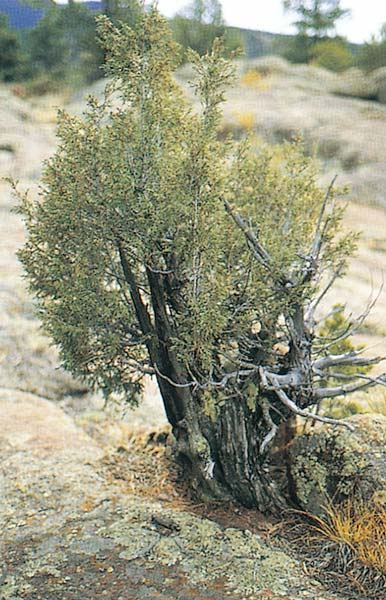
The base of this Juniper in the Rocky Mountains is more than 12" (30cm) wide. It is possibly over 500 years old, but, in spite of that, it can be collected because it is found in a crack full of humus
Many times
the experienced collector finds a tree that is good itself,
but knows that after collecting there will not be much chance
of it surviving. It is a very common situation since the best
material for bonsai is usually found in locations where the
conditions for survival are very harsh and so the trees are
weak and greatly castigated by nature often with roots that
are very ramified and exposed.
This means that you will not find a compact rootball and the
majority of the roots will break off and be lost in the collecting
process. The best rule is: in case of doubt, leave the tree
where it is.
Logically, no matter how good the tree may be, do not dig it up if the season is not right. Most trees that are found by chance and collected during vacations are not likely to survive.
If you find several suitable trees, but are unsure if they will survive, it is best to take only one in order to gain experience and to be able to collect the others later on.
Locations
can be found where, by collecting the trees growing there, you
are even saying them certain death. Such would be the case for
example, with those places where highways or roads through the
forest have been constructed or widened, where ski-lifts are
constructed or under lifts or high tension cables under which
all types of new growth is regularly destroyed.
As you may have read, even though it does not have to do directly
with bonsai, there are organisations dedicated specifically
to saving trees.
They may
also be found in pasture land where trees are regularly cleared
or in gravel pits and quarries that have to be enlarged.
So, therefore, these are locations where you can collect trees
that are practically condemned without feeling guilty.
The chief
objective of one who intends to collect a tree ought to be keeping
it alive. The chance of survival of the tree depend on:
· The experience of the enthusiast
· The type of tree
· The special conditions of the location
· The preparation of the tree
· The tools used
· The season of the year
· The amount of rain in the location where it is to be
collected (it has to have rained in previous days)
· The difference in climate between the place where it
was found and the location where it will be placed (the greater
the change, the more danger for the tree)
· Care after collecting